
A student read her Belbin GetSet report. She was one of a group, and I interpreted her profile in front of the others — what the data actually said about her, precisely and positively. She listened and said almost nothing. Afterwards she asked: "So it's okay that I'm like this?" It is the best question anyone has ever asked me. My answer was yes, of course it is. This is why so few young people already know that.
Date Created | Date Modified
2026-08-23
|
Author
Mats Soomre
Share this article
A student read her GetSet report. She was one of a group, and we worked through the profiles together. When we came to hers, I interpreted it with her in front of the others — not the words on the page, but what the data actually said about her. Precisely. Positively. Nothing softened and nothing dressed up.
She listened and she looked. In the group she said almost nothing.
Afterwards she asked:
"So it's okay that I'm like this?"
Yes, of course it is. You are very much OK
It is the best question anyone has ever asked me, and I have been doing this for twenty-eight years. Not because it was clever. Because of what it revealed: in all her young life, nobody had ever told her.
What young people have usually been told instead
By the time a young person nears the end of school, most of them have collected a set of corrections.
Too quiet, should contribute more in class. Too loud, should let others speak. Disorganised. Too slow to start. Too quick to argue. Doesn't finish things. Doesn't listen.
Each one may be accurate as an observation. Together they form a single message: there is a standard version of a good student, and you are falling short of it in these particular ways.
Then the same young person is put into a group project and assessed on how the group performs. Nobody has explained what working with other people consists of. Nobody has said that a group needs someone who argues, someone who finishes, someone who notices the flaw, someone who keeps people talking. So the group sorts itself out by volume and by habit, one person does most of the work, and everyone learns that group work is something to be endured.
Twelve years of individual measurement, followed by a working life spent almost entirely alongside other people. Somewhere in that gap, something is missing.
A conversation I keep having
Some years ago I was talking with an HR manager who was worried about the young people her company had recently hired.
The young people were not the problem, she was quick to say. What worried her was something else. At interview these candidates had been articulate, full of ideas, plainly capable. In the team, they struggled.
This is not unusual, and it is not a failure of the young people. It is a failure of what the interview measured.
Personal qualities — being a good communicator, being motivated, being conscientious — tell you very little about how someone will work alongside others. They tell you even less when the person has no work history at all, which is precisely the situation of every school leaver and most graduates.
And there is a further complication that personality language cannot handle. A good communicator among friends may be reserved in a meeting. The same person, genuinely, in both cases. Not inconsistent. Responding to context, as everyone does.
So the useful question is not what someone is like in general. It is how they behave in situations where work has to get done with other people.
Why behaviour rather than personality
Behaviour can be seen. That is the whole of it, and it is enough.
You cannot observe someone's introversion. You can observe that they think before speaking, that their ideas arrive fully formed, that they go quiet when interrupted. Those are behaviours, they happen in front of other people, and other people can describe them.
Behaviour also moves. It responds to the environment, to what the group needs, to what the person has learned to do. For anyone working with young people, this is the point that matters most: you are dealing with someone who is still forming, and behaviour is the layer where forming actually happens.
Belbin Team Roles describes nine clusters of behaviour that groups need in order to work as a team: generating ideas, finding opportunities outside the group, co-ordinating, driving, evaluating, holding the group together, turning plans into action, finishing to standard, and supplying deep knowledge. Everyone shows some of them strongly, some moderately, some hardly at all.
It is not a personality test and it does not sort people into types. It describes contribution — what this person brings when there is work to be done with others.
The nine behaviours, what each one costs, and how they combine are set out in Belbin Team Roles: The Practitioner's Guide to What Teams Actually Need.
What GetSet is
Belbin GetSet is the version built for young people who have not yet worked.
The questionnaire is constructed differently, because a young person cannot answer questions about how they behave in meetings, with direct reports, or under a manager. What they can answer is how they behave in a group that has to produce something — which is what school, sport, music, volunteering and student projects all are.
It produces the same nine behavioural team roles in the same language that organisations have been using for decades. So a young person leaves with a description of themselves that a university tutor or an employer will recognise, and that they can say out loud.
It works from two sources, not one: how the young person describes themselves, and how the people who work alongside them describe the same behaviour. That second source is where most of the value sits.
How observer feedback works, and who the observers should be
This is the part that does the work.
First, the young person describes themselves — the Self-Perception Inventory. Then people who have actually worked alongside them describe them independently (Observers Feedback) — classmates, project partners, teammates, anyone who has had to get something done with them.
Not parents. A parent's child is the cleverest and most capable in any room, and nothing usable survives that.
The two pictures are then compared. Sometimes they match closely. Often they do not, and the difference is the interesting part: something the young person values in themselves that others do not notice, or something obvious to everyone around them that they had never registered as a strength at all.
For most young people this is the first structured description of themselves they have ever received from people other than teachers and family. It is also the first time anyone has told them what they are good at in specific terms rather than encouraging ones.
The gap between how we see ourselves and how others experience us does not close with age. See Self-Awareness: You Think You Know Yourself. Your Team Sees Something Different.
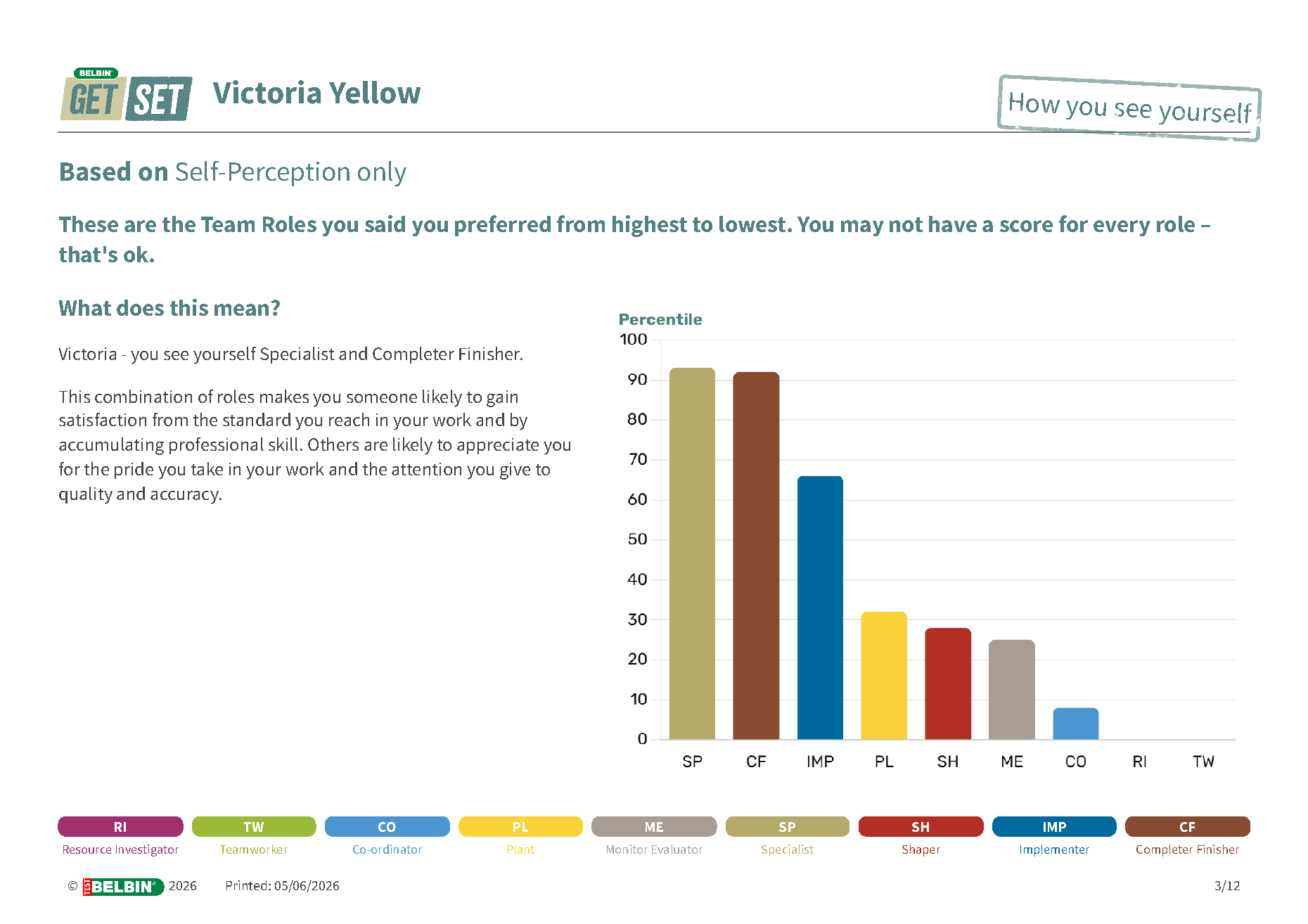
You can see what this looks like in the two sample reports attached to this article. Two young people, same instrument, entirely different pictures. Victoria is seen as a Specialist and Completer Finisher — her observers' most-ticked words were "dedicated to study", "perfectionist" and, interestingly, "tough". Jo is seen as a Shaper and Co-ordinator — her observers ticked "encouraging of others" eleven times, alongside "outspoken" and "confident and relaxed". Neither picture is better. Both are precise, both came from people who know them, and each tells its owner something she could not have written about herself.
Download sample GetSet report: Victoria Yellow — Specialist and Completer Finisher
The report is not the product
Handing a young person a report achieves very little. The paper is not where anything happens.
What matters is the conversation afterwards. Someone sitting with them and working through what it means. Not reading the words aloud — interpreting. Asking where they recognise themselves, where they do not, what surprised them, which observer comment they want to argue with.
And then comparing. Some of the best sessions I run are the ones where students look at each other's profiles. They see immediately that the person next to them is genuinely built differently — not better, not worse, differently. The quiet one is not failing to participate. The one who argues is not being difficult. Each is doing what they naturally do, and the group needs both.
That recognition changes how a group works far more than any individual report does.
It also means a school cannot buy this the way it buys textbooks. It needs someone able to interpret and to hold the discussion. Without that person, the reports are paper.
Why a young person's profile changes, and should
Here is the thing I say to every young group, and it is the most important sentence in this article.
Do not get stuck on the one or two roles at the top of your profile. Look wider. Test the others. Learn them. You will come to feel which set is becoming natural to you, and the result gets better.
A profile is a photograph of a moment, not a verdict. It shows how this person behaves in the settings they have been in so far — this school, these classmates, these tasks. Change the setting and the picture moves.
Six things shape behaviour. Only one is disposition.
This is not a disclaimer to protect the instrument. It is what the research says. In Team Roles at Work (chapter 3), Meredith Belbin sets out six things that produce team role behaviour, and disposition is only the first. Thinking can override it. A person's values can generate a whole set of behaviours by themselves. The immediate environment constrains what is possible. Experience shapes what gets adapted. And deliberately learning a role the group needs increases what a person can do.
One of six is what you were born with. The other five are thought, values, environment, experience and learning.
In young people this moves faster than in anyone else, because everything around them is changing at once — new institution, new subjects, a new group every term. A profile taken in the last year of school and another taken a few working years later will not be the same document, and they are not supposed to be.
Where confidence actually comes from
Confidence is the word everyone reaches for when they talk about young people, and it is usually treated as something to be injected — encouragement, praise, telling them to believe in themselves.
It does not work that way, and most young people know it. Praise without specifics slides straight off.
Confidence comes from having an accurate description of yourself that survives contact with how others see you. When you know your strengths specifically — not "good with people" but what you actually do that groups need — you can answer the question who are you? without guessing. In an application, in an interview, in a new group on the first day, you have something true to say, and you know the people who have worked with you would confirm it.
Every strength has a price, and saying it out loud is a skill
It reaches further than strengths. Every strength carries a cost — the driver can be impatient, the finisher can worry, the idea-generator loses the details. Belbin calls these allowable weaknesses, and the word does the work: allowable, because they are the price of a strength you actually want, to be managed rather than cured. Telling a young person that the cost of generating ideas is a loose grip on detail is more useful, and more honest, than telling them to be more organised. It also means they can talk about their weaknesses without shame, and say out loud how they cover them. Ask any recruiter how rare that is at any age.
Why trying to fix a weakness usually costs you the strength attached to it: Let's Talk About Weakness
The gear nobody has noticed yet
And underneath the visible strengths sits the hidden gear: behaviours a person can call on when the situation needs them, at some cost in energy, and which nobody — sometimes including the person — has noticed yet. Finding one of those in your own profile while still young changes what you think you are allowed to attempt.
Nine roles, thirty-six pairings
One more thing about the arithmetic, because it quietly destroys the fear of being put in a box. Nine roles combine into thirty-six different pairings, before anything else in the profile is counted. Look at the sample reports: each shows the top four roles as pairs, and each pair is its own working style with its own sentence — Victoria's "I use my knowledge and attention to detail to perfect things" is a different person at work than Jo's "I like taking overall responsibility for ensuring that group goals are met." Nobody is a type. Everybody is a combination, and the combination is theirs.
What a teacher gets from it
I have written mostly about the young person. There is a second beneficiary, and in schools it is often the more practical one.
A teacher who understands these nine behavioural team roles stops seeing a uniform class. The student who never volunteers an answer may be the strongest analyst in the room. The one who starts everything and finishes nothing is not lazy. The one who keeps asking about the deadline is not being difficult.
The two behaviours most often labelled difficult are usually the two a group cannot decide without: The Two People You Call Difficult Are the Two You Can't Decide Without
The reports make this immediately usable, because each one carries a short note on learning style. Look at the two attached. Victoria is likely to prefer studying on her own, and to enjoy project work where she can explore a subject and check it through carefully to avoid mistakes. Jo wants to understand the overall relevance of a subject, and may become impatient or frustrated with theories that do not seem to lead anywhere.
Same classroom, same material, same lesson. One of them needs to be left alone with the detail. The other will not engage with the detail at all until she has been told what it is for. Neither is a better student. A teacher who knows this makes a different decision on Tuesday morning, and both of them learn more.
It changes how group work is set up, because roles can be discussed rather than left to sort themselves out by volume. It changes what gets said at parents' evenings, because "your daughter is quiet in class" becomes something considerably more useful. And it changes what a teacher does with the student who has decided they are simply bad at teamwork.
Most teachers already sense these differences. What the framework adds is a shared vocabulary, so that the sensing can be discussed, taught and acted on.
Victoria's Self-Perception and 6 Observer Assessments breakdown | Victoria's working styles with How to handle inter views |
|---|---|
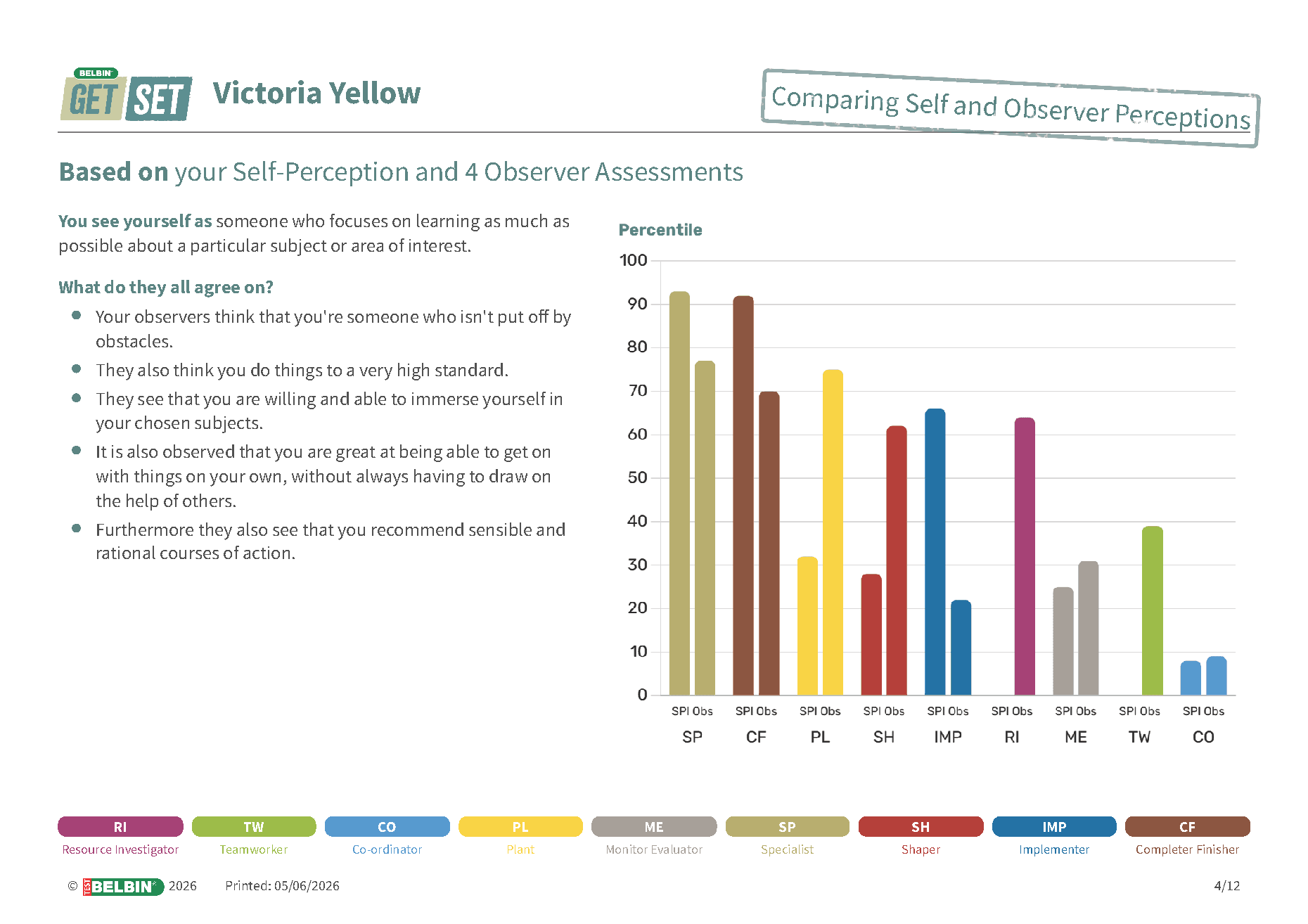 | 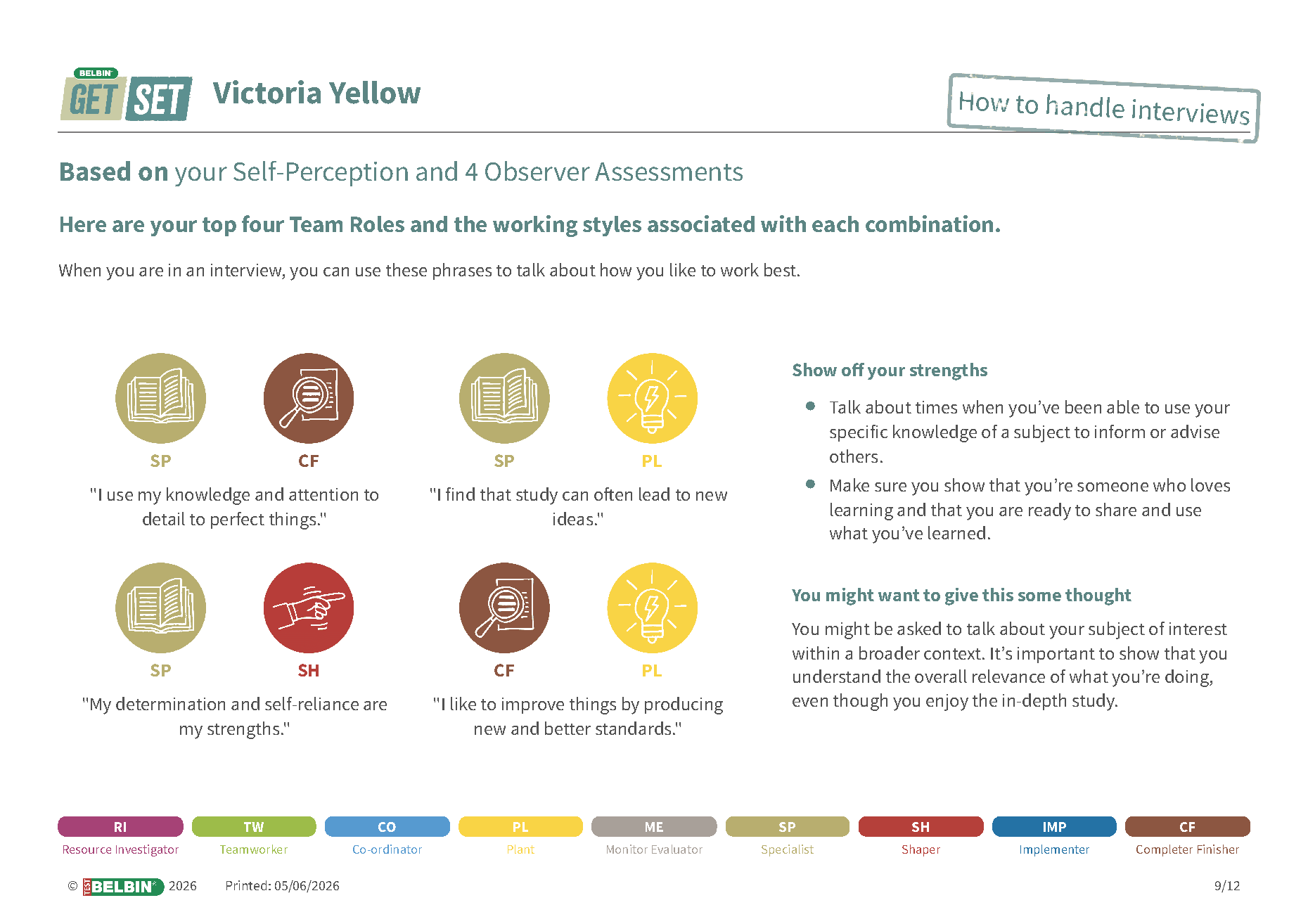 |
Download sample GetSet report: Victoria Yellow | |
Not about gender. Not about generation.
Assessment tools attract the suspicion that they sort people into categories. This one has earned the right to refuse it.
A team role profile contains no gender and no age. It describes behaviour — what a person does when there is work to be shared — and behaviour is the one layer where the youngest person in the room and the most experienced, in any combination, can be described in exactly the same language. The nine roles are used in the same form across countries. Cultures differ in how a behaviour is expressed and how it is received — what counts as direct, who speaks first, how disagreement is shown, how much silence a room tolerates. What does not differ is the set of contributions a group needs in order to work. Somebody has to generate the idea, somebody has to test it, somebody has to finish it. That is why the same nine behaviours describe a team in Tallinn, in Lisbon and in Tokyo, and why it works as a shared language for a group whose members come from all three.
The corrections young people collect are often gendered and often generational — who is told to speak up, who is told to settle down, what "young people today" are supposed to lack. A behavioural profile does not know any of that. It only knows what the people who worked with you saw.
A small note from where I work. The Estonian language has no grammatical gender — no he, no she, just tema for everyone. We speak to each other, and about each other, in the same way whoever we are. A team role profile works like Estonian. No gender, no age, no category. Just strong roles, hidden gear, and the honest price of both.
Back to the question
"So it's okay that I'm like this?"
She had spent years being told, gently and with good intentions, that she should be somewhat different. What she got that day was not permission to stop developing. It was an accurate description of what she already brought, in language that made sense, confirmed by people who worked with her — and an hour spent working out what it meant.
That is what changes. Not a career decision — this tells nobody which profession to choose, and any tool claiming otherwise deserves suspicion. What changes is that a young person stops guessing about themselves, and starts from something true.
Everything after that is easier.
Frequently Asked Questions (FAQ)
What is Belbin GetSet?
It is the version of Belbin Team Roles built for young people who have not yet worked.
GetSet helps a young person understand how they contribute when working with others. It combines self-perception with observer feedback, so a student sees not only how they describe themselves, but how classmates, teammates or project partners experience their behaviour in real group work. The questionnaire is worded for someone whose experience comes from school, sport, music or student projects rather than from a job, and it produces the same nine behaviours in the same language organisations have used for decades.
Does a young person's team role profile stay the same as they grow up?
No, and it is not meant to.
A profile describes behaviour in the settings that person has been in so far. Meredith Belbin's own model identifies six inputs behind team role behaviour, and disposition is only one — thinking, values, environment, experience and deliberate role learning account for the rest. In young people the picture moves quickly, because the institution, the subjects and the group all keep changing. Treat it as a photograph, not a verdict.
Who should the observers be for a young person?
People who have actually had to get something done alongside them — classmates, project partners, teammates, anyone from a group with a shared task.
Not parents. A parent's child is the cleverest and most capable in any room, and no usable data survives that. Four to six observers is the usual range. The value is not in the flattering words but in the comparison: what the young person sees in themselves, set against what people working with them see.
Does GetSet tell a young person which career to choose?
No. It describes how someone contributes to a group, not which profession to enter.
Belbin's own material states the same thing, and any assessment claiming to name a young person's future occupation deserves suspicion. What it gives is upstream of career choice: an accurate account of what they bring, in language a tutor or an employer recognises, so the young person can describe themselves rather than guess.
If you teach, run a careers programme, or lead a school, college or university department, the question is straightforward: do your students have any accurate account of what they bring to a group? Most do not, and most have never been asked. GetSet is not something you take off a shelf — it is set up for the group, with the interpretation built in, because that is the part that does the work. If it would be useful where you are, you are most welcome to write me.
And if you are a student reading this yourself: you do not need to wait for your school to think of it. Write to me and I will tell you how it works.
Cover photo by Mats Soomre · #MomentsBySoomre · moments.soomre.com